Union’s food drive brings in 800 pounds for The Hope Centre in Welland

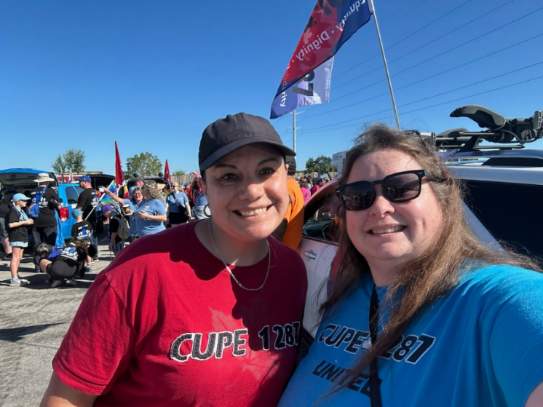
When Canadian Union of Public Employees (CUPE) 1287 put out a call for donations to support families facing food insecurity, dozens of workers of the local companies responded with food and money.

That generosity, amounting to 800 pounds, will be delivered by CUPE 1287 members to The Hope Centre in Welland on April 1

6.

The donation is part of CUPE 1287’s Strong Public Services — Strong Communities campaign and it comes at a time of significant economic uncertainty and turmoil in the Niagara Region, says a recent news release.

Food insecurity has surged in recent years, and Niagara Region food bank usage reached all-time highs in 2025. As the provincial government moves to reduce the voice of local residents and workers with strong chair powers, CUPE 1287 members are focused on giving back to their community.

The workers at The Hope Centre are also members of CUPE 1287. The donation is made on their behalf and on behalf of other CUPE 1287 members, including those who work at Canadian Mental Health Association, Town of Lincoln, Town of Pelham, City of Port Colborne, Township of Wainfleet, Township of West Lincoln, Humane Society of Greater Niagara, John Howard Society of Niagara, Niagara SPCA and Humane Society, Port Colborne Public Library, Regional Municipality of Niagara, and St. Catharines Museum.

“At a time when the voices of workers and residents are being sidelined, our members are stepping up in a different way, supporting our neighbours directly. This donation gives back to the community and honours the important work that CUPE 1287 members do at The Hope Centre every day. It’s part of our labour activism and reflects the values we hold dear as public-sector workers,” said Brenda Cervantes, president of CUPE 1287

“We are incredibly grateful to CUPE 1287 members and everyone who supported this drive for their generosity and solidarity. Donations like this make a real difference for the individuals and families we serve every day. Community support, especially in difficult economic times, is essential and this contribution will help when so many are feeling the strain,” said the Hope Centre in CUPE’s release.

https://www.pelhamtoday.ca/local-news/unions-food-drive-brings-in-800-pounds-for-the-hope-centre-in-welland-12142444

Union’s Food Drive April 16 2026


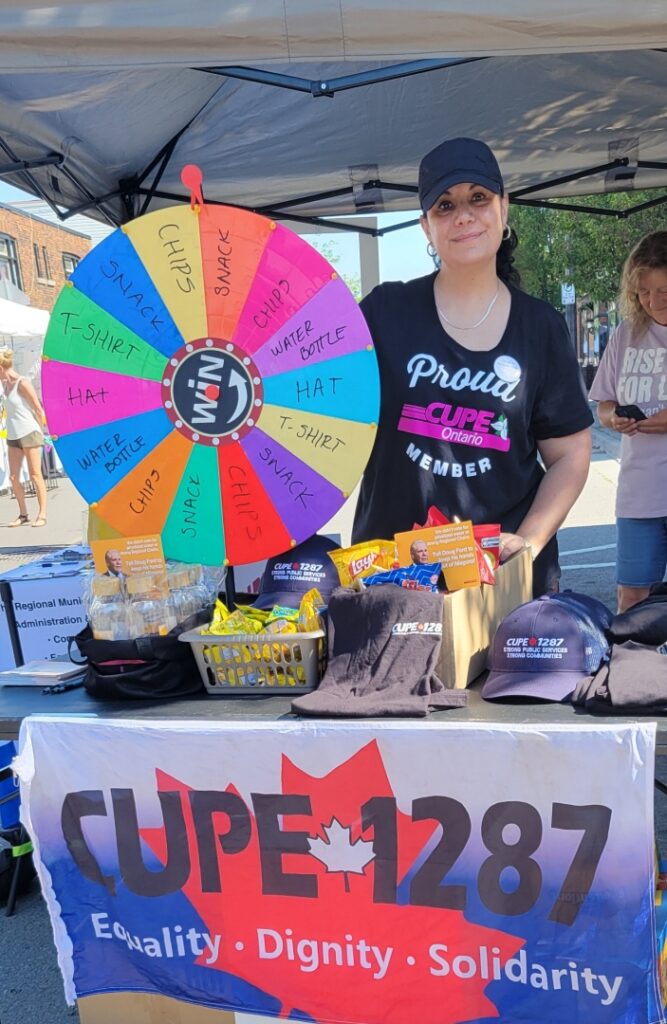
CUPE 1287 Pen Centre Information Table

Union members shared concerns regarding the Ford government’s recent announcement about major governance changes in the Niagara Region.

  • The Minister of Municipal Affairs and Housing said there will no longer be any directly elected councillors at the regional level.
  • Instead, the council will be made up of the 12 lower tier mayors and one appointed regional chair.
  • This means the size of council will be reduced to 13 from the previous 32.
  • Minister Rob Flack adding that the government will work with the region to create a weighted voting system to ensure appropriate representation.
  • The Regional Chair will also be granted ‘strong chair’ powers which includes the ability to appoint and dismiss the region’s Chief Administrative Officer and other division heads, as well as determine the organizational structure of the region.
  • All changes will take effect for the upcoming term of council.

How could these changes impact taxpayers?

  • Less democracy, more centralized control. Less democracy more appointed leaders with similar views and goals. Fewer elected representatives and more appointed leadership may reduce accountability and limit diverse perspectives. For example, when Bob Gale was appointed, he wrote to the province proposing amalgamation options without taxpayer consultation.
  • Reduced representation and increased workload. Regional councillors and mayors already manage demanding responsibilities. Concentrating governance in 12 mayors may limit their capacity to effectively represent constituents. This could lead to the need for additional staff, potentially increasing administrative costs.
  • Potential inequities through weighted voting. A weighted voting system may create imbalances between communities—for example, between rural and urban municipalities—affecting whose voices carry more influence in decision-making.
  • Lack of transparency and public consultation. Significant unknowns remain. No detailed plan has been presented to taxpayers, and there has been no meaningful public consultation. At the March 26 council meeting, it was confirmed that it was too late to include a ballot question in the October 2026 municipal election.
  • No clear financial or housing benefit. Minister Rob Flack has acknowledged that these changes “will not save money” and are not intended to accelerate housing development.

So, what is the real objective?

If these changes will not reduce costs, improve housing outcomes, or enhance representation, taxpayers are left asking:

Why is this restructuring being imposed without consultation?

What problem is the government trying to solve—and who truly benefits from these changes?

Pen Centre Information Table March 28 2026
Pen Centre Information Table April 4 2026

Resources

Better Regional Governance Act 2026

CUPE 1287 Seaway Mall Information Table

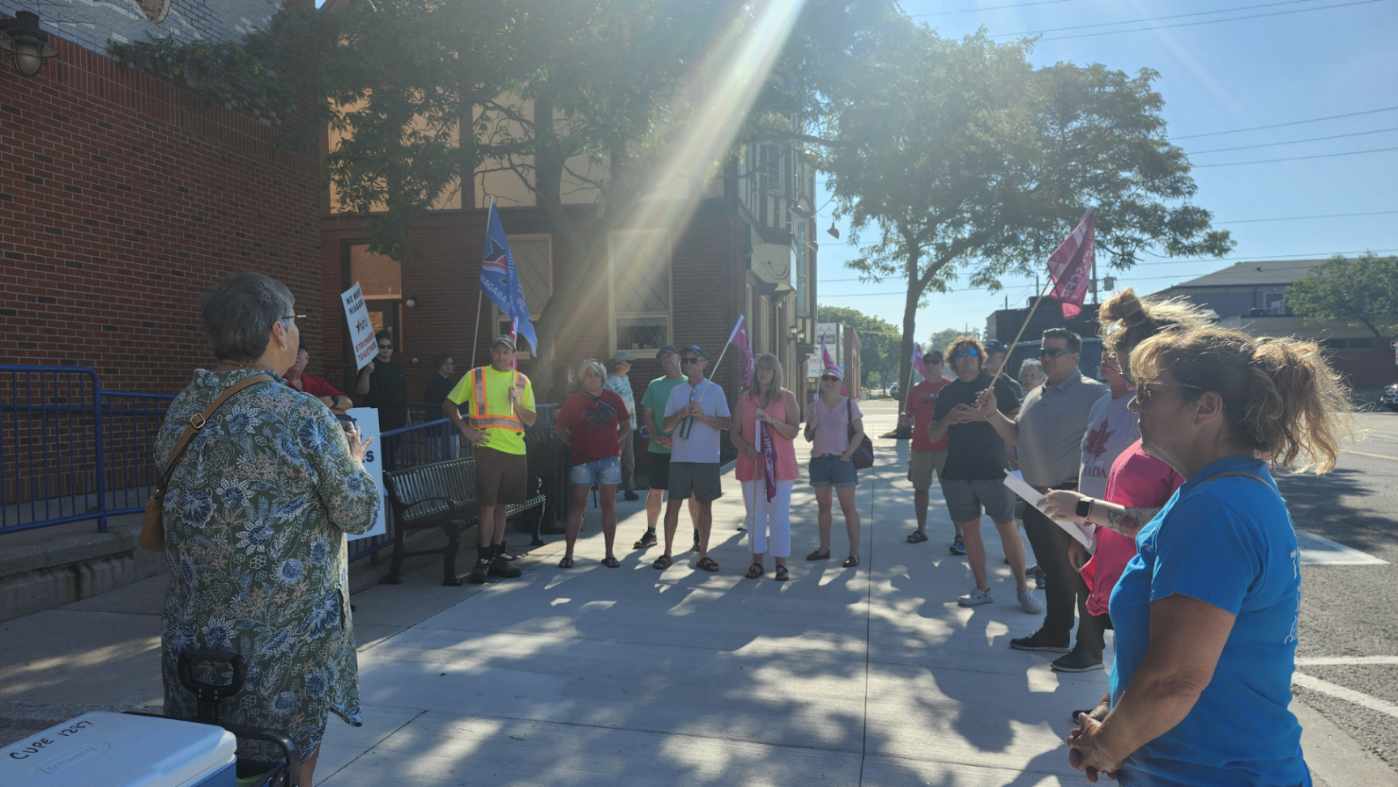
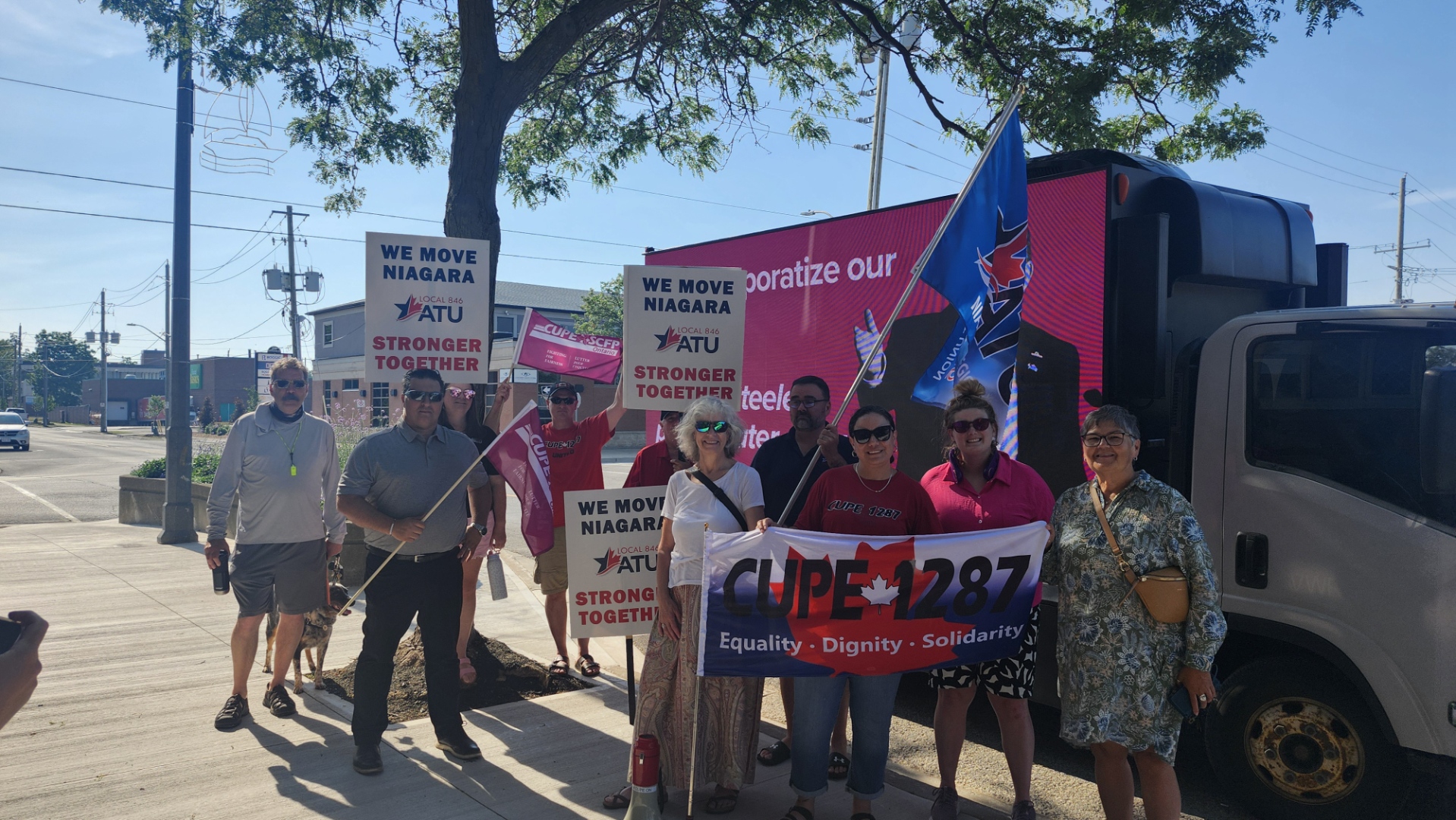
Union members had the opportunity to engage with the Public, speaking about the work they do in our communities and the importance of it.

  • Social Assistance Casemanagers spoke about the vulnerable community they serve such as the challenges of affording housing with such low income. For example, a single person receives $390.00 per month to pay for rent and bills.
  • Child Care Workers spoke about the lack of supports from the Provincial level impacting the worker to child ratio. Children requiring specific resources to build a foundation to succeed in their school journeys fall between the cracks as a result of long waiting times and lack of funding.
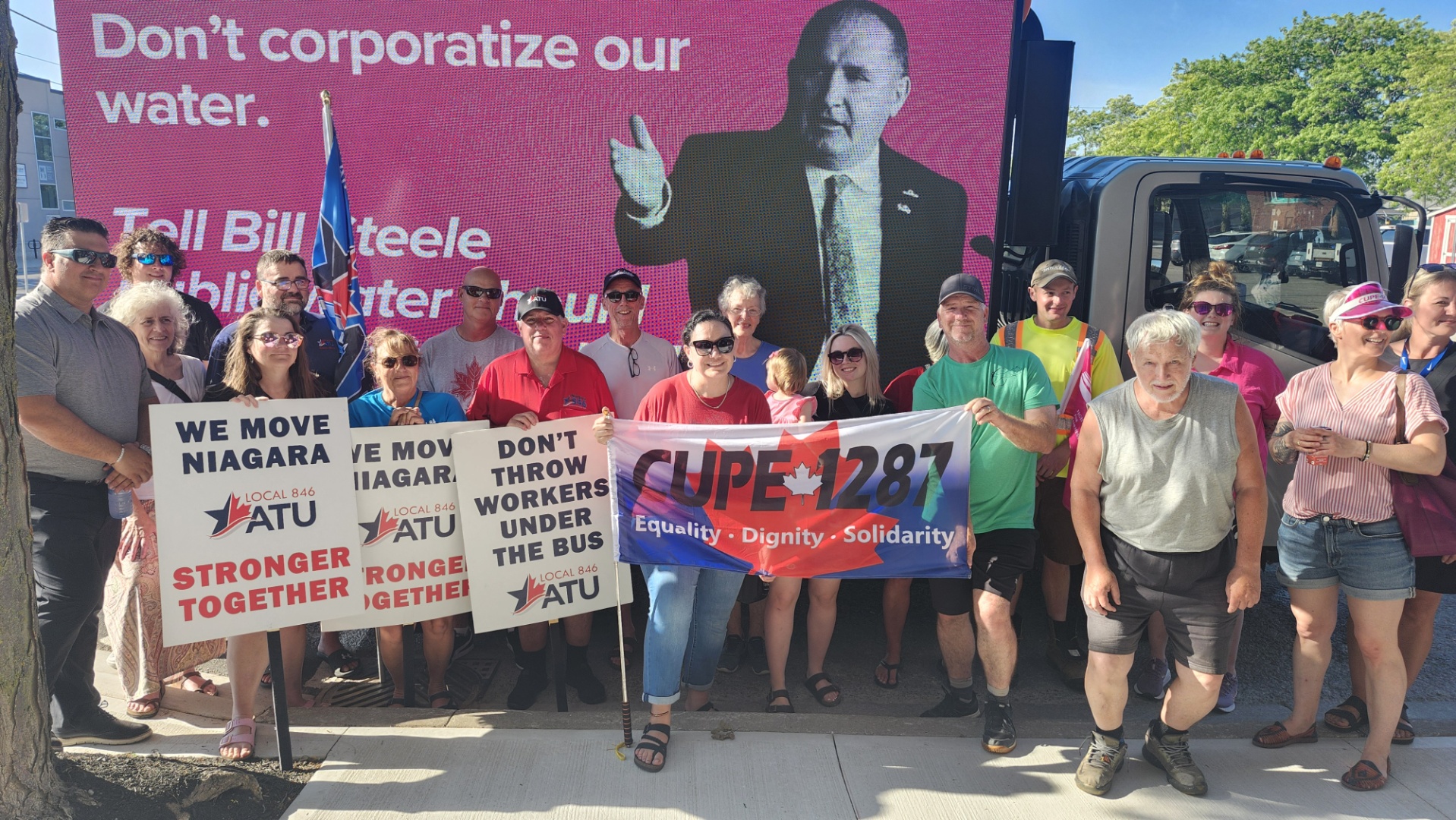
  • Water and Wastewater Operators spoke about the water privatization: the impacts on the environment, tourist industry, taxpayers, water cost and more.

We are going to continue setting up tables at different venues sharing the love and commitment we have for our jobs and the community we serve.

CUPE 1287 Seaway Mall Information Table March 7, 2026
CUPE 1287 Seaway Mall Information Table February 21, 2026

CUPE 1287 Water Privatization and Political Amalgamation Forum – Action Needed

CUPE 1287 Water Privatization and Political Amalgamation Forum – Action Needed

As we continue to engage with CUPE members and the public regarding the political amalgamation and water privatization in Niagara Region more changes have happened.

March 11th at 10:22 am 610 CKTB – CUPE opposed to Niagara amalgamation and merging of water services

https://610cktb.com/advertise/

March 11th at 9:26 pm 610 CKTB – Niagara Chair Bob Gale resigns over art collection, including alleged ‘Mein Kampf’ book signed by Hitler

https://610cktb.com/advertise/

CUPE 1287 will be hosting an online public forum on March 19th at 6:00 pm. There will be guest speakers addressing political amalgamation ramifications, the socioeconomic impacts and experience of water privatization, job insecurity, democracy, representation, municipal elections and more. See attach poster with Zoom link QR code.

WE NEED TO EDUCATE OURSELVES AND THE PUBLIC, THESE ARE OUR COMMUNITIES AND WE MUST BE CONSULTED.

Action Item: Share our posters on your social media, with your loved ones and local businesses. There is strength in numbers, and we all have the responsibility to act to defend our community, environment, jobs and democracy.

CUPE 1287 Water Privatization and Political Amalgamation Forum – Action Needed

https://cupe1287.com/wp-content/uploads/sites/410/2026/03/Screenshot-449.png

https://cupe1287.com/wp-content/uploads/sites/410/2026/03/Screenshot-450.png

CUPE Ontario condemns Niagara mayors’ “water for power” proposal amidst widespread provincial overreach

Toronto – The proposed amalgamation of Niagara municipalities is the latest example of Premier Doug Ford’s attempt to override local democracy in pursuit of his agenda, says CUPE Ontario.

Ford has built his political brand on speeding up development, yet he has accomplished little actual building as progress has consistently stalled around the same issues: local input, environmental oversight, and the limits of water and wastewater infrastructure. CUPE Ontario says that helps explain the government’s sweeping attacks on conservation authorities and public water systems through omnibus legislation.

Those pressures are now playing out in Niagara, where eight municipal mayors sent a letter last week to the province offering to trade public water to stave off amalgamation.

“The province has made its agenda clear: it doesn’t care about local voices, expert advice, or the lessons of history,” said Fred Hahn, president of CUPE Ontario. “For mayors to even suggest putting their residents’ water on the table to protect their own jobs is disgraceful.” Hahn was referring to a joint letter from the mayors of Fort Erie, Grimsby, Port Colborne, West Lincoln, Pelham, Thorold, Wainfleet, and Niagara-on-the-Lake. While opposing amalgamation, the letter invites the creation of water and waste-water corporations that risk turning public water into a profit-driven enterprise.

“Privatizing water and merging municipalities are both old, tired conservative experiments,” Hahn said. “We’ve tried them before and the evidence is clear: water privatization is a disaster and amalgamation costs residents more money.”

Municipal restructuring and water privatization are separate issues, but the fact they are being linked in negotiations reveals how political leaders are willing to trade away public services. “Instead of standing up for our communities, some mayors appear ready to put Niagara’s water on the bargaining table,” said Brenda Cervantes, president of CUPE Local 1287, which represents workers across Niagara Region. “They’re fighting to protect their own political positions while offering up the jobs of the regional workers who maintain our water systems. That’s not leadership.”

Bill 60, passed with minimal public consultation, allows public water and wastewater services to be shifted to private corporate-style utilities incorporated under the Business Corporations Act. Experts warn that such changes can increase costs for ratepayers while undermining accountability and public oversight. Meanwhile, the idea of amalgamating Niagara municipalities has been promoted to find “efficiencies,” despite little evidence that municipal mergers deliver long-term savings. Independent reviews of past amalgamations — including in

Toronto, Hamilton, Ottawa, and Chatham-Kent — have consistently found that mergers bring significant upfront costs while projected savings rarely materialize.

“In Peel Region, Ford tried to break up the region. In Niagara, he’s flirting with amalgamation. There’s no coherent principle here, just a willingness to pave the ground of well-connected developers,” said Hahn. “This has never been about saving money for municipalities. It’s another attempt to remove every obstacle standing in the way of Ford’s developer buddies, including environmental protections, public water systems, and the ability of residents to have a meaningful voice in local government.”

CUPE Ontario is calling on Niagara municipalities to take water privatization off the table entirely, commit to keeping water services publicly owned and operated, and listen to residents who have spoken out strongly against amalgamation.

Welcome to our new website

We’re excited to launch this new site to help keep you informed about everything that’s happening in our local.  If there’s anything you’d like to see, or you’ve got any feedback, please contact the CUPE 1287 office at office@cupe1287.com